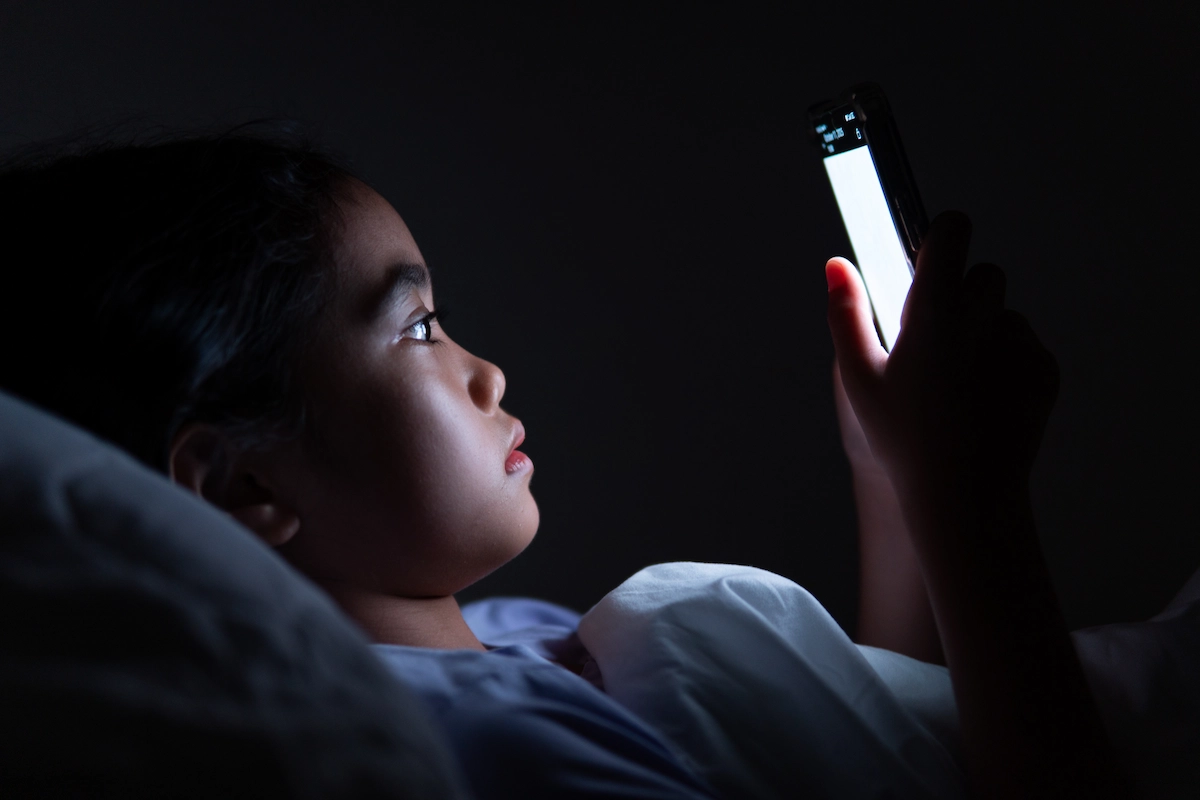
Screens do not directly cause myopia on their own, but too much close-up screen use may contribute to a child’s risk of developing or progressing myopia — especially when it replaces time outdoors. Myopia, or nearsightedness, makes distant objects look blurry while close-up objects remain clear.
Because children’s eyes are still growing, it is important to watch for early vision changes. Myopia management can help monitor nearsightedness and build a plan to protect your child’s long-term eye health.
How can screen time affect myopia?
Using a tablet, phone, computer, or handheld game requires the eyes to focus up close for extended periods. Research suggests that more near work and less time outdoors are associated with a higher likelihood of myopia in children.¹
Screen time is only one piece of the picture. Genetics also matter: children with one or both nearsighted parents have a greater risk of becoming nearsighted themselves. Reading, homework, and other close-up activities can also add to the amount of near work in a child’s day.
The goal is not necessarily to eliminate screens. Instead, it is to create healthier habits that balance close-up tasks with regular breaks and outdoor play.
Why does outdoor time matter?
Outdoor time is one of the most practical ways to support healthy visual development. Exposure to natural daylight and looking at objects farther away give children’s eyes a break from sustained near focus. The American Association for Pediatric Ophthalmology and Strabismus encourages one to two hours of outdoor play each day for children.²
Families can make outdoor time part of the routine by:
- Walking the dog, riding bikes, or visiting a playground
- Choosing outdoor sports or after-school activities
- Taking homework or reading breaks outside when practical
- Building screen-free outdoor time into weekends
Outdoor time does not replace regular eye care, but it can be a helpful habit for children who are at risk for myopia.
What are signs that a child may be nearsighted?
Children may not realize their vision has changed, so they may not mention that distant objects look blurry. Watch for signs such as:
- Squinting to see the board, television, or signs
- Sitting very close to screens
- Frequent headaches or eye fatigue
- Losing their place while reading
- Trouble seeing during sports or other distance activities
A school vision screening can identify some concerns, but it does not replace a complete eye exam. A pediatric eye exam evaluates vision, eye coordination, focusing skills, and overall eye health.
Can myopia be managed?
Yes. While glasses and standard contact lenses correct blurry distance vision, myopia management focuses on slowing how quickly nearsightedness progresses in childhood. This matters because higher levels of myopia can increase the risk of retinal detachment, glaucoma, cataracts, and myopic macular degeneration later in life.
Our doctor can assess your child’s vision and eye health, monitor changes over time, and recommend options based on their needs. Depending on the child, those options may include children’s eyewear that supports clear, comfortable vision or myopia control contact lenses designed around their vision and lifestyle.
Protect your child’s vision as they grow
Screen time is part of modern childhood, but regular outdoor time, healthy screen habits, and routine eye exams can help parents stay ahead of vision changes. If your child is squinting, struggling to see at a distance, or spending more time on close-up tasks, an eye exam can identify whether myopia is a concern.
We provide personalized myopia management and pediatric eye care to help children see clearly today while supporting healthier vision for the future. Schedule an appointment to discuss your child’s vision needs.
References